When we think of the heroes of World War II, the image that comes to mind is often a soldier in the trenches or a pilot in the cockpit. If we think of codebreakers, we might picture Alan Turing standing before a massive machine. But there is another image, far quieter but just as lethal to the Axis powers: a woman sitting in a chair, the rhythmic click-click-click of knitting needles flying in her hands.
To the casual observer, or a German guard, she was just doing “women’s work,” a domestic necessity in a time of rationing. But in reality she might have been one of the war’s most effective agents, and her skills with thread and pattern were the very foundation of modern computing and encryption.
Let’s look back at how the invisible architecture of textile work helped win a war and build the digital world we live in.
The Original Binary Code
To understand how weavers became codebreakers, we have to look at the technology that preceded the computer: the loom. In 1804, Joseph-Marie Jacquard invented a way to automate the weaving of complex patterns like brocade and damask. He used a series of stiff pasteboard cards with holes punched in them. If there was a hole, a hook could pass through and lift a thread; if there was no hole, the thread stayed down. It was a simple system: Yes or No. On or Off. One or Zero.
This was the world’s first practical application of binary code.
When Charles Babbage began designing his “Analytical Engine” – the Victorian ancestor of the computer – he didn’t invent the input method from scratch. He borrowed it from the textile industry. As his collaborator Ada Lovelace famously wrote, “The Analytical Engine weaves algebraic patterns just as the Jacquard loom weaves flowers and leaves.”
For generations, women had been the masters of this machinery. They possessed the “textile mind”: the ability to visualize complex, interlocking patterns, to spot a single dropped stitch in a field of thousands, and to execute repetitive, high-precision algorithms with their hands. When the war came, this specific skillset was exactly what the Allies needed.
Knitting as Spycraft
While the loom provided the theoretical basis for computing, the humble knitting needle became a tool of active espionage. Take the story of Phyllis Latour Doyle. A secret agent for the British Special Operations Executive (SOE), she parachuted into occupied Normandy in 1944. Her cover was simple: she was a helpful young woman who rode her bicycle around the countryside, chatting with German soldiers.
While she chatted, she was knitting. But she wasn’t just making socks. She was encoding information.
The binary nature of knitting, composed entirely of knit stitches and purl stitches, maps perfectly onto Morse code. A knit stitch for a dot, a purl stitch for a dash. Phyllis and other agents like her would knit messages into scarves and hats. The Belgian Resistance used a similar method, recruiting elderly women whose windows overlooked train yards. As enemy trains passed, they would knit: a drop stitch for a troop transport, a purl for an artillery car. By the time the fabric was finished, it was a hard-data log of enemy logistics, readable only by those who knew the code.
Because knitting was seen as innocuous “busy work” for women, it was the perfect camouflage. It allowed women to sit in plain sight, documenting the war machine without ever raising a rifle.
The Human Computers of Bletchley Park
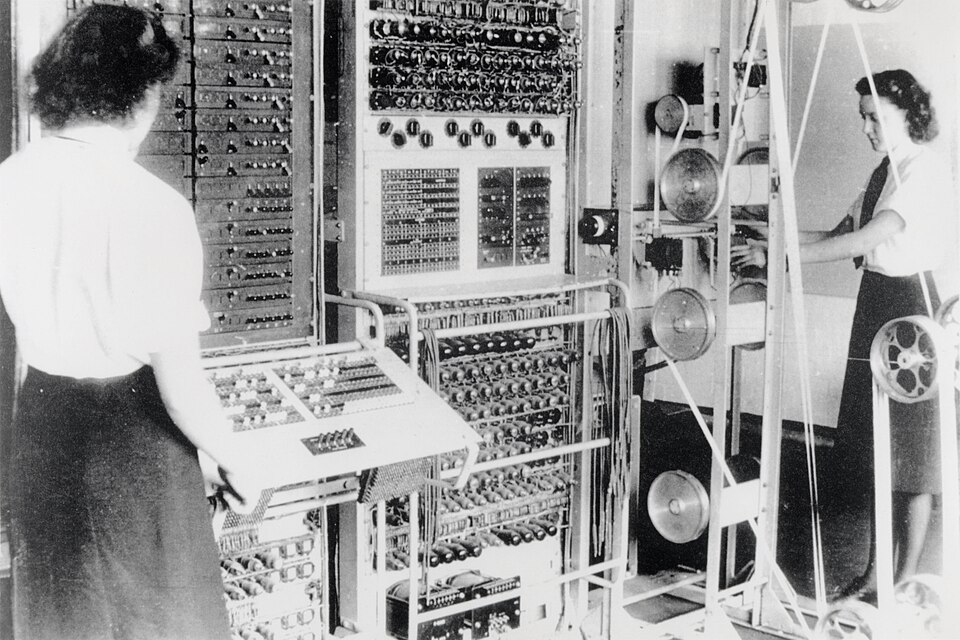
The connection between textiles and code-breaking reached its industrial peak at Bletchley Park. This was the home of the Colossus, the world’s first electronic programmable computer, designed to break the sophisticated Lorenz cipher used by the Nazi High Command.
The Colossus was a beast of a machine, using paper tape filled with punched holes – direct descendants of the Jacquard cards. Who operated these machines? Almost exclusively women, specifically members of the Women’s Royal Naval Service (Wrens).
These women were recruited for their “dexterity and patience,” but that description undersells their contribution. They were managing the flow of data. They had to thread the paper tapes through the optical readers at forty miles per hour, synchronizing the mechanical rhythms to find the “pattern” that would crack the German code. It was a high-stakes version of threading a loom. If the tape tore, the calculation failed. If the timing was off, the code remained unbroken.
The women of Bletchley Park were not just pushing buttons; they were operating the loom of history, weaving the intelligence that would eventually secure the Allied victory.
The Pattern of Connectivity
The story of these women proves that making and thinking are deeply intertwined. The manual skill of the weaver informed the intellectual leap of the computer programmer. The patience of the knitter became the vigilance of the spy.
So the next time you see a complex pattern, whether it’s in a line of code, a set of blueprints, or a hand-knit sweater, remember the thread that connects them all.
Punch Card Looms and Early Computing
This video perfectly illustrates the mechanical link between the Jacquard loom’s punch cards and the early computing logic that defined the code-breaking machines of WWII.